


Chinese For Beginners
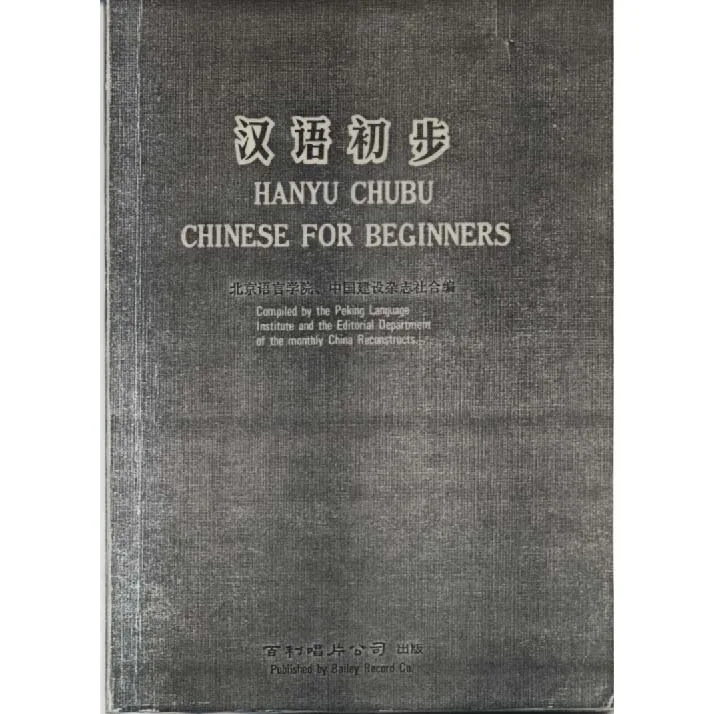
Publisher: Bailey Record Co
Format: Paperback
ISBN: none
Chinese for Beginners (1976) by Peking Language Institute & the Editorial Department of the monthly China Reconstructs (Bailey Record Co.)
ISBN: none | Condition: Good | Sold by Crappy Old Books
(Strange photocopy-based book, but with three stitched signatures — which is frankly more commitment than most modern relationships.)
Here’s a book that doesn’t just teach you Chinese — it teaches you the deeper, more timeless lesson that “beginner” is a state of mind, and sometimes also a state of mild paper-related confusion. Chinese for Beginners (1976) arrives with all the quiet confidence of an era when language learning involved grit, repetition, and the belief that you could simply power through unfamiliar symbols by force of will and a decent cup of tea.
This is not one of your glossy, app-friendly, colour-coded, dopamine-dripping modern courses that congratulates you for recognising the concept of a noodle. No — this is a photocopy-based creature, the kind of book that looks like it has been assembled with practical optimism and a sturdy disregard for contemporary design trends. It feels faintly clandestine, like something passed across a desk with a knowing nod: “This will get you started. Don’t ask too many questions.” And yet — wonderfully, reassuringly — it’s also been put together with real physical seriousness: three stitched signatures, as if the makers decided that even if the world is uncertain, the binding shouldn’t be.
Compiled by the Peking Language Institute and the editorial department of China Reconstructs, it carries that unmistakable mid-century instructional tone: calm, methodical, and subtly insistent that you are perfectly capable of learning a whole new writing system if you simply apply yourself and stop being dramatic about it. It’s the sort of book that doesn’t “hold your hand” so much as place your hand firmly on the desk, point at the page, and say, again, but politely. There’s a particular charm in that. You can almost hear the implied encouragement: You will learn this. You will also sit up straight while doing so.
As a historical object, it’s a small time capsule: a snapshot of how China was presented to learners in the 1970s, and how learners were expected to behave (earnestly, repeatedly, and without demanding a progress bar). As a practical item, it’s still a pleasing way to begin — especially if you like your study materials to feel like artifacts rather than “content.” It has that admirable quality of books that were made to be used: to be opened flat, pencilled in, revisited, and gradually conquered.
Condition is Good, which suits it perfectly: this isn’t pristine, showroom language learning. This is workmanlike learning, the kind that involves flipping back a page, muttering “right,” and trying again. If you want a curious, slightly oddball, genuinely characterful beginner’s guide — part language textbook, part photocopied mystery, part stitched-together determination — this one is ready for its next brave student.
Sold by Crappy Old Books, where even the strangest textbooks get a second life, and every “beginner” is one cup of tea away from fluency (or at least from confidently ordering something and receiving a bowl of soup you didn’t expect).
Keep browsing: See more Langauge books Other books by Peking Language Instituteand thje Edirorial Department of the monthly China Reconstructs
